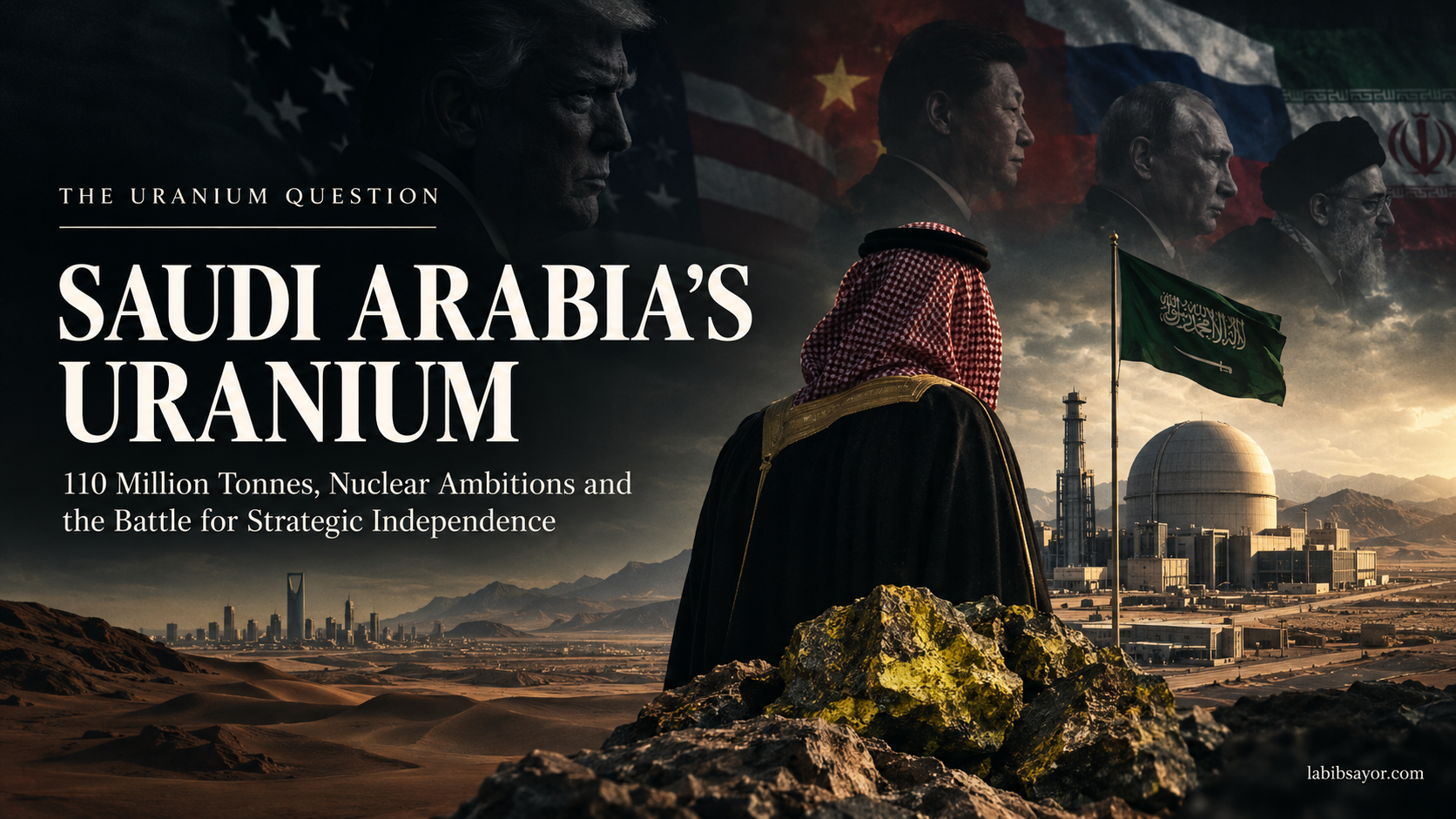
There are discoveries that change an economy, and there are discoveries that change the imagination of a state.
Saudi Arabia’s reported uranium resources belong, at least potentially, to the second category.
The number that has travelled around the world is spectacular: roughly 110 million tonnes of ore in the Madinah region, containing rare earth elements and promising concentrations of uranium. Within hours, the internet did what the internet always does when it encounters the words “Saudi Arabia” and “uranium” in the same sentence. Headlines became more dramatic, the number became detached from its geological meaning, and 110 million tonnes of ore started appearing in public discussion as though Riyadh had suddenly discovered 110 million tonnes of uranium metal sitting beneath the desert.
It has not.
That distinction matters.
In fact, the real story is considerably more interesting than the exaggerated one.
Saudi Arabia has spent years trying to build something far more consequential than another mining project. It wants a domestic nuclear industry. It wants uranium mining. It wants yellowcake. It wants nuclear fuel. It wants reactors. Its energy minister has openly discussed developing the entire nuclear fuel cycle, including low enriched uranium and fuel manufacturing. Riyadh has also spent years cultivating nuclear relationships with China, Russia, South Korea, France and, increasingly, the United States.
And now, almost immediately after Washington and Riyadh signed a new civil nuclear cooperation agreement, Saudi Arabia has publicly placed a huge uranium bearing geological resource into the conversation.
So the real question is not whether Saudi Arabia has discovered 110 million tonnes of uranium.
It has not.
The real question is this:
What happens when a country that already possesses extraordinary energy wealth decides that it does not want to remain merely an exporter of energy, but wants to control more of the technology, fuel and industrial infrastructure through which energy itself is produced?
That is a much more uncomfortable question for Washington.
First, let us kill the 110 million tonne myth
On September 14, 2026, Saudi Energy Minister Prince Abdulaziz bin Salman announced at the International Atomic Energy Agency’s General Conference in Vienna that exploration and geological studies at the Jabal Sayid project in the Madinah region had identified an estimated resource of roughly 110 million tonnes of ore containing high concentrations of rare earth elements, particularly heavy rare earths, alongside promising concentrations of uranium.
Some reports have carried the figure as approximately 114 million tonnes. That discrepancy appears to reflect different reporting of the same Saudi announcement rather than two separate discoveries.
The important word is ore.
Ore is not the same thing as uranium.
A uranium orebody is rock or mineralized material that contains uranium at some concentration. The mass of the ore can be enormous while the actual amount of uranium contained within it is a small fraction of that mass.
Imagine 100 million tonnes of rock containing uranium at a fraction of a percent. You do not possess 100 million tonnes of uranium. You possess 100 million tonnes of material from which some amount of uranium might potentially be extracted.
The distinction becomes even more important because Saudi Arabia’s announcement also concerns rare earth elements. Jabal Sayid is being discussed as a polymetallic resource, not as some enormous underground block of pure uranium.
This is why the number should be treated carefully.
The newly released 2026 edition of the OECD Nuclear Energy Agency and IAEA Uranium Resources, Production and Demand, commonly called the Red Book, provides a much more useful framework for understanding Saudi Arabia’s actual uranium position. The Red Book distinguishes between different categories of uranium resources according to geological confidence and economic recoverability.
A review of the Saudi data in the new edition puts a significant Saudi uranium resource at roughly 31,700 tonnes of uranium, with another body of resources classified as inferred. That is measured in tonnes of uranium, or tU, rather than tonnes of uranium bearing rock.
Those numbers are not interchangeable with the 110 million tonne ore figure.
If one were to take 31,700 tonnes of contained uranium and divide it mechanically by 110 million tonnes of ore, the result would be approximately 288 parts per million, or about 0.029 percent uranium. But that calculation should not be presented as the actual grade of the Jabal Sayid material, because the public information does not establish that the 31,700 tonnes and the 110 million tonnes refer to precisely the same resource boundary.
It is merely an illustration of how dramatically different the two measurements are.
This is the first thing that has been lost in the excitement.
Saudi Arabia has not suddenly become the country with 110 million tonnes of uranium.
It has identified an enormous quantity of mineralized ore with uranium potential, and its wider uranium resource base is becoming much more significant.
That is still important.
Just not for the reasons the viral headlines suggest.
The more important discovery is not the number. It is the direction.
Saudi Arabia has been working on uranium for years.
The kingdom’s own nuclear energy program describes uranium and thorium exploration as a strategic project tied directly to Vision 2030. The stated objectives include establishing measured resources, developing local industrial capacity, creating employment, diversifying income and securing nuclear fuel for future reactors.
That last part is crucial.
Saudi Arabia does not want to simply buy nuclear fuel forever.
It wants to participate in making it.
The Saudi National Atomic Energy Project has been built around several components, including nuclear power, small modular reactors, regulation and the nuclear fuel cycle. Saudi official material explicitly describes domestic uranium resources as a potential source of fuel for national reactors and as a possible commodity for international markets.
This is not a conspiracy theory.
It is Saudi policy.
The kingdom has also said that it wants to exploit uranium from more than one source. One pathway involves conventional uranium deposits such as Jabal Sayid. Another involves recovering uranium as a byproduct of phosphoric acid production in the country’s phosphate industry. Saudi officials say pilot work with French nuclear company Orano has produced promising economic indicators for that route.
That is a very Saudi way of approaching the problem.
Saudi Arabia is not looking at uranium in isolation. It is trying to build a broader mining and industrial ecosystem around resources that already exist inside the kingdom.
The uranium question therefore belongs to Vision 2030.
The objective is not simply to replace oil with uranium.
It is to move Saudi Arabia upward in the energy value chain.
Oil made Saudi Arabia rich because Saudi Arabia possessed the resource. But oil also created a peculiar form of dependency. The kingdom could export crude, import advanced technology, import machinery, import weapons and import much of the industrial expertise required to convert resource wealth into geopolitical power.
Nuclear energy offers something different.
A functioning nuclear industry requires engineers, regulators, metallurgists, chemists, fuel specialists, construction companies, precision manufacturers, universities, research institutions, safety systems and long term industrial planning.
A reactor is not merely a power plant.
It is an industrial school.
And uranium is the beginning of that chain.
Saudi Arabia’s nuclear ambitions are bigger than electricity
There is an understandable tendency to describe Saudi nuclear ambitions as an attempt to produce electricity and desalinate water.
That is true.
It is also incomplete.
Saudi Arabia burns large quantities of hydrocarbons domestically. Every barrel of oil consumed in power generation or industrial applications is a barrel that cannot be exported or converted into higher value products.
Nuclear power can therefore become an economic tool.
If Saudi Arabia can replace some domestic oil and gas consumption with nuclear electricity, it can free hydrocarbons for export, petrochemicals or other uses.
The kingdom is also becoming an enormous electricity consumer. Desalination, industrial development, data centers, artificial intelligence infrastructure and the electrification of economic activity all require energy.
There is an irony here.
Saudi Arabia is simultaneously one of the world’s great fossil fuel powers and one of the countries with a very strong incentive to reduce its dependence on burning fossil fuels at home.
The nuclear program fits that contradiction surprisingly well.
The oil era made Saudi Arabia powerful.
The post oil strategy may make Saudi Arabia more independent.
That is why the uranium question matters.
And then there is the United States
This is where the story becomes genuinely geopolitical.
Washington has never viewed Saudi Arabia merely as another customer.
For decades, Saudi Arabia has been one of the central pillars of the American security architecture in the Middle East. Oil has been part of it. Military cooperation has been part of it. Intelligence cooperation has been part of it. Arms sales have been part of it. The protection of Gulf energy infrastructure has been part of it.
But the relationship has always contained a contradiction.
The United States wants Saudi Arabia to be strong enough to serve American strategic interests, but not so strategically autonomous that Washington loses leverage over it.
Nuclear technology goes straight to the heart of that contradiction.
The United States and Saudi Arabia signed a Section 123 civil nuclear cooperation agreement in July 2026. The US Department of Energy described the agreement as the foundation for a decades long nuclear partnership and emphasized the commercial advantages for American companies.
That language tells us something.
Washington is not simply worried about proliferation.
Washington also wants to win the Saudi nuclear market.
Westinghouse and other American companies have enormous commercial interests in the global nuclear revival. Saudi Arabia is one of the largest potential new nuclear markets in the Middle East.
The American nuclear industry wants the contract.
The American national security establishment wants influence over what Saudi Arabia builds.
The nonproliferation community wants restrictions.
Congress wants oversight.
And Saudi Arabia wants sovereignty.
These interests do not naturally fit together.
They collide.
For years, Washington insisted that Saudi Arabia accept restrictions on enrichment and reprocessing. Congressional policy had previously linked nuclear cooperation with restrictions on enrichment and reprocessing and stronger IAEA verification.
The comparison with the United Arab Emirates is particularly revealing.
When the UAE signed its 123 agreement with Washington in 2009, it accepted a commitment not to enrich uranium or reprocess spent fuel domestically. This became known as the “gold standard” of American nuclear cooperation.
Saudi Arabia has never been enthusiastic about accepting the same restriction.
And why would it be?
From Riyadh’s perspective, uranium is a sovereign resource.
If Saudi Arabia can mine it, why should it be forbidden from processing it?
If it can process it, why should it be forbidden from enriching it?
If it is a member of the Nuclear Non Proliferation Treaty and accepts safeguards, why should its rights be narrower than those of another non nuclear weapons state?
This is the argument Saudi officials have been making for years.
And this is where the Western nuclear order becomes politically uncomfortable.
The nuclear rules are universal, until they become inconvenient
There is a perfectly legitimate nonproliferation argument against allowing Saudi Arabia to enrich uranium.
Enrichment technology is dual use.
The same basic technological infrastructure used to make reactor fuel can be used, with further enrichment, to produce material suitable for nuclear weapons.
That is not propaganda.
It is nuclear physics.
The problem is that the international system has never applied the political implications of that fact evenly.
Iran is told that enrichment is an intolerable proliferation risk.
Yet enrichment itself is not prohibited under the NPT for non nuclear weapons states that comply with safeguards.
Japan enriches uranium.
South Korea has pursued sensitive fuel cycle capabilities.
Brazil enriches uranium.
Germany participates in enrichment through European multinational arrangements.
The Netherlands does too.
And then there are the nuclear weapon states themselves, which possess enormous enrichment capabilities because they developed them before the current nonproliferation regime matured.
Then there is Israel, which has never joined the NPT and is widely believed to possess nuclear weapons, while maintaining a policy of deliberate nuclear ambiguity.
The Western response to these cases has never been identical.
It cannot be.
The international nuclear order is not merely a technical system.
It is a hierarchy of power.
The rules are written as universal principles, but their political enforcement is shaped by alliances, history, strategic interests and military power.
That is the uncomfortable truth behind much of the Middle Eastern nuclear debate.
When Iran enriches uranium, Washington sees a possible bomb.
When Saudi Arabia seeks enrichment, Washington asks how to make the enrichment facility American.
That is a fascinating distinction.
It may even be understandable from the perspective of American strategy.
But it is difficult to describe it as purely neutral nonproliferation policy.
Washington’s Saudi dilemma has now become much harder
The new US Saudi agreement reportedly creates a pathway for Saudi enrichment.
The publicly available details are more complicated than the early headlines suggested.
Under the agreement, uranium enrichment using US transferred technology would initially be limited to 5 percent uranium 235. A later joint study could potentially open the way to enrichment below 20 percent, subject to additional conditions.
The distinction matters because 5 percent is conventional reactor fuel territory, while 20 percent is still civilian low enriched uranium but represents a much more proliferation sensitive position.
And this is precisely why the agreement has generated controversy.
The United States has spent years warning about the dangers of enrichment in the Middle East.
It is now constructing a framework through which its ally may eventually obtain it.
That is not necessarily hypocrisy in the narrow legal sense. There are safeguards, limitations and political conditions.
But it is certainly a striking geopolitical contradiction.
Washington wants to prevent nuclear proliferation while simultaneously ensuring that the Saudi nuclear industry remains tied to American technology.
In other words, the American solution to proliferation may be American control.
That is very different from Saudi strategic autonomy.
The 110 million tonnes make this question more interesting
Now imagine Saudi Arabia develops its uranium resources commercially.
Not 110 million tonnes of uranium.
Actual uranium resources.
Enough to make domestic mining economically meaningful.
Then imagine Riyadh develops yellowcake production.
Then conversion.
Then fuel fabrication.
Then domestic enrichment under international safeguards.
At that point Saudi Arabia would no longer simply be buying nuclear power plants.
It would possess a meaningful portion of the nuclear fuel chain.
That changes the political calculation.
A country that imports reactor fuel is dependent on international suppliers.
A country that mines uranium but imports fuel is less dependent.
A country that converts and fabricates fuel domestically is less dependent again.
A country that enriches uranium has acquired a strategically sensitive capability.
That capability does not automatically mean a nuclear weapons program.
But it changes what the country could theoretically do.
This is why uranium is never merely about uranium.
It is about optionality.
And states care enormously about optionality.
Saudi Arabia does not need a bomb to gain leverage
This is one of the most important points that tends to disappear in sensational discussions.
Strategic autonomy does not require a nuclear warhead.
Saudi Arabia could gain considerable geopolitical leverage simply by possessing a credible domestic fuel cycle.
It could tell Washington that it wants American technology, but it does not absolutely need American fuel.
It could tell China that it wants Chinese expertise, but it does not need to surrender its entire nuclear program to Beijing.
It could negotiate with Russia without becoming dependent on Russian fuel.
It could even become a supplier of nuclear fuel or uranium products in the long term.
The kingdom would have options.
And options are power.
This is the deeper significance of the uranium announcement.
Saudi Arabia has spent decades being powerful because other countries needed its oil.
The next phase may involve becoming powerful because Saudi Arabia itself has choices.
China has been in this story for much longer than Washington would like
The Chinese role is not new.
In 2017, China National Nuclear Corporation signed agreements with the Saudi Geological Survey concerning uranium and thorium resources. Chinese geological teams conducted fieldwork across multiple areas of Saudi Arabia.
CNNC itself described the cooperation as part of an effort to build broader nuclear cooperation with Saudi Arabia.
This matters because China was involved in the geological side of the Saudi uranium story before Washington had finalized its new nuclear partnership.
China also discussed cooperation with Saudi Arabia on uranium extraction from seawater.
More recently, Saudi and Chinese officials have discussed nuclear fuel, uranium exploration and mining, and peaceful nuclear energy.
That is not accidental.
China sees nuclear technology as an industrial export.
Saudi Arabia sees nuclear technology as a tool of national development.
The two interests fit remarkably well.
China does not necessarily need Saudi Arabia to become a nuclear weapons state.
Beijing can gain influence simply by becoming useful to Saudi Arabia’s civilian nuclear ecosystem.
And that is precisely the sort of influence Washington dislikes losing.
China offers something America cannot easily offer
China does not approach the Middle East with the same political baggage as the United States.
It does not demand that every strategic relationship fit neatly into an American alliance system.
Beijing is perfectly comfortable selling infrastructure, reactors, mining technology, telecommunications equipment, industrial machinery and energy systems to governments with which Washington has complicated political relationships.
This gives Saudi Arabia room to maneuver.
Riyadh does not need to choose between Washington and Beijing.
It can play both.
That is increasingly the Saudi method.
American security.
Chinese industrial capacity.
European technology.
Russian nuclear expertise.
South Korean engineering.
Saudi capital.
This is not ideological consistency.
It is strategic diversification.
And perhaps that is exactly the point.
Russia is another option, although a different one
Russia’s Rosatom has also been among the companies competing for Saudi Arabia’s first major nuclear power project.
Rosatom’s model is particularly attractive to countries that want an integrated nuclear package. Russia can offer reactor construction, fuel supply, training, technical services and long term operational support.
The Russian model therefore creates another form of strategic relationship.
China offers industrial depth.
The United States offers technology, finance, commercial access and the extraordinary strategic weight of the American security system.
Russia offers a vertically integrated nuclear ecosystem with a willingness to operate through long term state backed arrangements.
For Riyadh, having all three available is strategically useful.
The Saudi government does not need to announce that it is abandoning Washington.
It simply needs to demonstrate that Washington is not the only option.
That is how leverage works.
And then there is Iran
Iran is the country that will watch all of this most carefully.
Not because 110 million tonnes of ore suddenly gives Saudi Arabia a bomb.
It does not.
Iran knows that.
The Iranian calculation is about trajectory.
If Saudi Arabia moves from uranium exploration to uranium mining, from mining to yellowcake, from yellowcake to conversion, and from conversion to enrichment, Tehran will see a growing Saudi capability that could survive changes in the political relationship between Riyadh and Washington.
Iran will also notice something else.
The United States is now willing to contemplate an enrichment pathway for Saudi Arabia while simultaneously treating Iranian enrichment as a central security crisis.
From Tehran’s perspective, the message is obvious.
The problem is not enrichment itself.
The problem is who controls it.
That perception can be dangerous.
Because nonproliferation regimes depend not only on technical rules but on legitimacy.
If countries conclude that nuclear rules are simply instruments through which powerful states decide who may possess which technologies, incentives to comply can weaken.
Saudi Arabia has already given Iran a warning
In 2018, Mohammed bin Salman told CBS that Saudi Arabia did not want nuclear weapons, but that if Iran developed one, Saudi Arabia would follow as soon as possible.
That statement has never disappeared.
It is part of the strategic background to every Saudi nuclear negotiation.
Saudi Arabia does not need to repeat it every year.
Everyone remembers it.
That is why a domestic Saudi enrichment capability will always be interpreted through the Iranian question.
If Iran remains non nuclear weapon state but possesses substantial enrichment capability, Saudi Arabia will want comparable rights.
If Iran becomes a nuclear weapons state, the situation becomes dramatically more dangerous.
And if the United States simultaneously weakens its traditional opposition to Saudi enrichment, the old regional balance becomes even more complicated.
Israel will have a different reaction
Israel’s position is even more complicated because Israel itself is widely believed to possess nuclear weapons while maintaining nuclear ambiguity.
Israel has historically been deeply opposed to the spread of nuclear capabilities in the Middle East.
That position is understandable from an Israeli security perspective.
But it also creates one of the most obvious contradictions in the region.
Israel can possess an undeclared nuclear arsenal.
Iran cannot be permitted to develop a full fuel cycle without intense international pressure.
Saudi Arabia is expected to remain permanently below a threshold that Israel itself crossed decades ago.
That is not a stable long term arrangement.
Israeli officials and political figures have already expressed concern about the possibility of Saudi enrichment.
Former Israeli Defense Minister Avigdor Lieberman, for example, publicly warned that the Saudi civilian program could eventually produce a nuclear arms race.
The Israeli fear is rational.
But so is the Saudi argument.
If Israel’s security doctrine assumes that nuclear superiority must remain uniquely Israeli, then every emerging regional nuclear capability becomes a threat.
If Saudi Arabia sees Iran as an existential competitor and Israel as a nuclear armed state tolerated by Washington, Riyadh will naturally ask why Saudi Arabia should permanently accept technological inferiority.
This is how arms races begin.
Not necessarily because governments suddenly want war.
Sometimes they begin because governments become convinced that the rules were never designed to protect them.
The Gulf is entering a different strategic era
For decades, the Gulf security structure was relatively simple.
The United States provided the security architecture.
Saudi Arabia and the Gulf monarchies provided energy, investment and strategic access.
Iran was the principal regional challenger.
Israel was America’s closest regional military partner.
That structure is now becoming more complicated.
Saudi Arabia has improved relations with China.
Saudi Arabia has restored diplomatic relations with Iran.
Saudi Arabia has expanded relations with Russia.
Saudi Arabia has pursued independent diplomatic positions on Palestine.
Saudi Arabia has invested massively in its own defense industry.
And now it is building a nuclear program that potentially includes a domestic fuel cycle.
This is not a Saudi break with America.
It is something more sophisticated.
It is a Saudi attempt to make the relationship less asymmetric.
That distinction matters.
Riyadh does not need Washington to disappear.
It wants Washington to understand that Riyadh has alternatives.
The oil analogy is impossible to avoid
There is a historical irony here.
The entire architecture of the modern Saudi American relationship was built around oil.
American industry needed energy.
Saudi Arabia possessed extraordinary petroleum reserves.
The United States offered security, weapons, investment and access.
The arrangement became one of the defining strategic bargains of the twentieth century.
Now Saudi Arabia is trying to do something similar with a very different resource base.
Oil gave the kingdom money.
Uranium could give it technological leverage.
Rare earths could give it access to strategic industrial supply chains.
Nuclear power could reduce domestic dependence on hydrocarbons.
Mining could become a new pillar of the Saudi economy.
The country is trying to turn natural resources into industrial sovereignty.
That is exactly what Washington should expect a powerful state to do.
And yet when the resource is uranium, the political atmosphere changes immediately.
Suddenly the word “sovereignty” becomes “proliferation.”
The American double standard deserves serious criticism
The United States has legitimate reasons to worry about Saudi enrichment.
But American policy also deserves scrutiny for a deeper reason.
Washington has repeatedly treated nuclear technology as a geopolitical privilege.
The history is full of examples where American governments tolerated sensitive nuclear capabilities among allies while applying far greater pressure to adversaries.
The most obvious regional example is Israel.
The broader global examples include the way the United States has accommodated the nuclear capabilities of friendly states while treating proliferation among hostile states as a threat to international order.
India is another complicated example.
India never joined the NPT, developed nuclear weapons outside the treaty framework and later received a major US civil nuclear cooperation arrangement that effectively integrated India into parts of the global nuclear economy.
Iran, meanwhile, has spent decades facing sanctions, diplomatic pressure, sabotage and military threats over a nuclear program that Tehran insists is civilian, even as questions about safeguards and undeclared nuclear material have produced serious international concerns.
One can support nonproliferation while still asking whether the system is applied consistently.
In fact, genuine nonproliferation requires asking that question.
If the rule is that uranium enrichment is inherently dangerous, then it should be dangerous regardless of whether the centrifuges are in Tehran, Riyadh, Seoul, Tokyo or Brasilia.
If the rule is that safeguarded civilian enrichment is legitimate, then that principle should be defended consistently.
Otherwise the nuclear order begins to look less like a universal legal regime and more like a hierarchy of permissions.
And that is precisely the kind of system that eventually loses credibility.
Washington’s real fear is not 110 million tonnes
Washington is not frightened by a number.
It is frightened by what the number could become.
The United States does not need Saudi Arabia to possess 110 million tonnes of uranium.
It needs Saudi Arabia to remain strategically connected to the American system.
That means American companies building reactors.
American technology entering Saudi institutions.
American standards becoming embedded in Saudi regulation.
American fuel supply remaining commercially attractive.
American security guarantees remaining valuable.
And, above all, Washington retaining enough influence to ensure that Saudi nuclear development does not become an independent strategic capability.
This is why the new 123 agreement is so important.
It gives Washington a seat inside the Saudi nuclear project.
But it also creates a paradox.
The more Washington insists on controlling Saudi nuclear development, the more incentive Riyadh has to diversify its nuclear partnerships.
China is waiting.
Russia is waiting.
France is waiting.
South Korea is waiting.
Saudi Arabia has no reason to place every egg in the American basket.
What if Washington tries to pressure Riyadh?
There are several possible futures.
- Washington could attempt to negotiate stronger safeguards.
- It could push Saudi Arabia toward a model closer to the UAE.
- It could condition nuclear cooperation on broader strategic concessions, including normalization with Israel or restrictions on sensitive fuel cycle activities.
- It could use American export licensing as leverage.
- It could threaten to restrict technology transfers if Riyadh moves beyond agreed enrichment limits.
- Or it could do something much more pragmatic.
It could accept Saudi enrichment under tightly controlled conditions because Washington would rather have an American monitored Saudi fuel cycle than a Chinese or Russian one.
The last option may ultimately be the most realistic.
Because American policymakers understand something uncomfortable.
If Washington says no, Saudi Arabia may simply ask Beijing.
And if Beijing says yes, Washington has lost influence rather than prevented nuclear development.
That is the central dilemma.
Nonproliferation policy based on denial becomes much harder when the denied state has money, strategic importance and multiple suppliers.
Saudi Arabia has all three.
This is why China matters so much
China does not need to build a Saudi bomb to weaken American influence.
It only needs to help Saudi Arabia build enough civilian nuclear infrastructure that Riyadh has another supplier, another source of expertise and another political relationship.
That is sufficient.
The same applies to Russia.
A Saudi nuclear program involving multiple international partners would be difficult for Washington to dominate.
And from Riyadh’s perspective, that is probably desirable.
Saudi strategic autonomy is not about becoming anti American.
It is about making “American” and “Saudi” interests less synonymous.
That is a major difference.
There is another uncomfortable question: why uranium at all?
Saudi Arabia has no shortage of energy.
It has oil.
It has gas.
It has sunlight.
It has capital.
Why spend enormous sums developing nuclear power and uranium mining?
Because energy abundance is not the same thing as energy independence.
A country can have enormous oil reserves and still become vulnerable if its power infrastructure, shipping lanes, refining systems or foreign technology supply chains are threatened.
Saudi Arabia is learning this lesson in real time.
Energy infrastructure can be attacked.
Shipping routes can be disrupted.
Pipelines can be targeted.
War can turn an energy exporter into an energy security problem overnight.
Nuclear power offers a different kind of resilience.
It is not invulnerable.
Nothing is.
But a diversified energy system is harder to coerce than a system overwhelmingly dependent on one fuel.
That is the logic behind Saudi nuclear development.
The 110 million tonne story may therefore matter less as a mining story than as a political signal
This is the part I find most interesting.
Saudi Arabia announced the Jabal Sayid resource at the IAEA, the institution at the center of the global nuclear order.
The announcement emphasized not only uranium but rare earths.
It emphasized economic utilization.
It emphasized international partnerships.
It emphasized transparency.
It emphasized the national nuclear program.
And it came only weeks after the United States and Saudi Arabia signed their new nuclear cooperation agreement.
That timing is impossible to ignore.
It does not prove that Riyadh made the announcement as a message to Washington.
But politically, it functions as one.
We have resources.
We have money.
We have nuclear ambitions.
We have international partners.
And we intend to build value chains inside our own country.
Washington can participate.
But Washington does not own the project.
That is a very different message from the Saudi Arabia of twenty years ago.
But we should not romanticize Saudi autonomy either
There is a temptation among critics of American power to treat every Saudi move away from Washington as inherently progressive.
That would be lazy.
Saudi Arabia is not suddenly an anti imperialist state.
It is a monarchy pursuing its national interests.
It has its own military interventions, regional rivalries, authoritarian structures and geopolitical ambitions.
Strategic autonomy is not automatically justice.
A country can become more independent from Washington and still behave badly.
The point is not to celebrate Saudi Arabia.
The point is to recognize that sovereignty means the ability to make choices without requiring permission from another great power.
If Saudi Arabia develops nuclear energy peacefully, under safeguards, with transparent regulation and without developing nuclear weapons, that is a legitimate sovereign project.
If Washington tries to restrict peaceful nuclear technology solely because it does not want Saudi Arabia to become too independent, that deserves criticism.
If Saudi Arabia uses civilian nuclear infrastructure as a disguised route to nuclear weapons, that deserves criticism too.
The standard has to be the same.
Otherwise this entire debate becomes nothing more than geopolitical tribalism.
The real danger is not Saudi uranium. It is an unequal nuclear order
The greatest danger in the Middle East is not that Saudi Arabia has uranium.
The region has uranium.
The danger is that countries conclude that security requires capabilities that the international system will not allow them to possess openly.
Iran’s nuclear trajectory is partly a product of its security environment.
Israel’s nuclear posture is a product of its security environment.
Pakistan’s nuclear program emerged from its conflict with India.
India’s nuclear program emerged from its conflict with China and Pakistan.
North Korea’s nuclear program is rooted in regime survival.
Nuclear weapons rarely emerge in a vacuum.
They emerge from fear.
If Saudi Arabia ever moves toward a nuclear weapons capability, the world will need to ask why.
And the answer will not simply be “because Saudi Arabia found uranium.”
It will be because Saudi leaders concluded that their security environment demanded it.
That is a much harder problem to solve.
So, can Saudi Arabia actually become a nuclear power?
Yes, eventually.
But not because someone found 110 million tonnes of ore.
Mining uranium is only the beginning.
The material has to be economically recoverable.
It has to be processed.
Yellowcake has to be produced.
Conversion has to occur.
Fuel fabrication requires industrial capability.
Enrichment requires sensitive technology and sophisticated infrastructure.
Reactors require enormous capital and technical expertise.
Regulation has to work.
Safeguards have to work.
Waste management has to work.
And the entire system has to survive decades of political change.
That is why the current Saudi program should be judged by what happens over the next ten or twenty years, not by the headline of September 2026.
The geology is important.
The institutions are more important.
Saudi Arabia’s next battle will be over the fuel cycle
This is where I think the real geopolitical contest will occur.
The reactor itself is almost the easy part.
Saudi Arabia can buy a reactor.
The difficult question is what happens before the reactor and after the reactor.
Who mines the uranium?
Who processes it?
Who converts it?
Who enriches it?
Who fabricates the fuel?
Who supplies replacement fuel?
Who owns the technology?
Who trains the engineers?
Who controls the software?
Who certifies the facilities?
Who inspects them?
Who has access to the data?
Who can shut the system down?
These are questions of sovereignty.
And sovereignty is exactly why nuclear fuel cycles become politically explosive.
Washington understands this.
Beijing understands this.
Moscow understands this.
Riyadh certainly understands it.
The final question
So what does Saudi Arabia’s uranium discovery actually mean?
It does not mean Saudi Arabia has discovered 110 million tonnes of pure uranium.
It does not mean Saudi Arabia is about to build a nuclear bomb.
It does not mean the Middle East has suddenly entered a nuclear arms race.
And it certainly does not mean that Saudi electricity will soon be powered by an enormous desert uranium deposit.
What it does mean is that Saudi Arabia is accumulating the ingredients of something much more consequential.
- Domestic uranium resources.
- Rare earth resources.
- A national nuclear program.
- Plans for nuclear power.
- Plans for fuel production.
- International partnerships.
- Chinese experience.
- Russian competition.
- French expertise.
- American technology.
- Saudi capital.
- An increasingly explicit desire for strategic autonomy.
The uranium is only one piece.
The political significance comes from how the pieces fit together.
For Washington, this creates a dilemma that American foreign policy has repeatedly struggled to solve.
The United States wants Saudi Arabia strong.
It wants Saudi Arabia secure.
It wants Saudi Arabia to remain a partner.
It wants American companies to build Saudi reactors.
It wants to prevent nuclear proliferation.
But it also wants to preserve American leverage.
Those objectives can coexist only as long as Saudi Arabia accepts a certain level of dependence.
And Saudi Arabia is spending billions precisely to reduce dependence.
That is the contradiction.
The United States spent decades constructing a Middle Eastern order in which security flowed from Washington, technology flowed largely from the West, and energy flowed out of the Gulf.
Saudi Arabia is now trying to construct something different.
Not an anti American order.
A post dependency order.
That is much more interesting.
And potentially much more dangerous for the old system.
Because the most powerful form of sovereignty is not the ability to say no.
It is the ability to say, “No, because I have another option.”
If Saudi Arabia eventually learns how to take uranium from its own ground, turn it into fuel, power its own reactors, train its own engineers and sell nuclear products abroad, then the significance of Jabal Sayid will not be measured in tonnes.
It will be measured in choices.
And great powers become nervous when smaller powers acquire choices.
For decades, Washington has treated the Middle East as a region in which American security guarantees, American weapons, American technology and American diplomatic weight were ultimately difficult to replace.
That assumption is now being tested.
China is offering alternatives.
Russia is offering alternatives.
Saudi Arabia is building alternatives.
The Gulf states are diversifying their diplomacy.
And the nuclear question sits right in the middle of it.
There is a final irony here.
The international nuclear order claims to be built on universal rules.
But the history of nuclear politics suggests something else.
The world does not merely ask whether a country can be trusted with nuclear technology.
It asks whether the country is trusted by the powerful.
That is a different question.
And Saudi Arabia, armed with money, uranium resources, strategic geography and multiple international partners, is increasingly in a position to ask an even more uncomfortable question in return:
Who exactly gave Washington the right to decide how much technological sovereignty Riyadh is allowed to possess?
That question is bigger than uranium.
It is about power.
It is about resources.
It is about empire.
And ultimately, it is about whether sovereignty is genuinely universal, or merely something the powerful permit when it does not threaten their influence.
The answer may be written not in a reactor, not in a centrifuge, and not even in the desert beneath Madinah.
It may be written in the moment Saudi Arabia discovers that it no longer needs permission.
Research Notes
The first and most important source is the September 2026 statement by Saudi Energy Minister Prince Abdulaziz bin Salman at the IAEA General Conference. Contemporary reporting of the Saudi Press Agency account gives the Jabal Sayid estimate as roughly 110 to 114 million tonnes of ore, containing heavy rare earth elements and promising uranium concentrations. The wording is critical because it describes ore, not 110 million tonnes of uranium metal.
The second major source is the OECD Nuclear Energy Agency and IAEA’s Uranium 2026: Resources, Production and Demand, the latest edition of the international uranium Red Book. It provides the technical framework for distinguishing identified recoverable resources, inferred resources and uranium measured as tonnes of uranium rather than tonnes of ore.
The previous 2024 Red Book is also important because it already listed Saudi uranium resources associated with Jabal Sayid and the Ghurayyah polymetallic deposit, demonstrating that Saudi uranium exploration did not begin with the September 2026 announcement.
Saudi Arabia’s own Ministry of Energy material on its Nuclear Fuel Cycle Unit establishes that Riyadh’s uranium exploration program is explicitly connected to Vision 2030, domestic employment, resource diversification and securing nuclear fuel for future reactors.
Saudi nuclear policy documents establish that the National Atomic Energy Project includes nuclear power, small modular reactors, regulation and nuclear fuel cycle development.
The US Department of Energy’s July 2026 announcement establishes that Washington and Riyadh signed a Section 123 peaceful nuclear cooperation agreement alongside a bilateral safeguards agreement, and that the agreement is intended to provide American companies with access to the Saudi nuclear market.
The Congressional Research Service’s analysis of US Saudi nuclear cooperation provides the historical background to Washington’s long running insistence on stronger nonproliferation conditions, including restrictions on enrichment and reprocessing and the Additional Protocol.
The Arms Control Association’s September 2026 analysis of the final agreement is especially important for understanding the enrichment issue. It reports that enrichment using US transferred technology would initially be limited to 5 percent uranium 235, with a possible pathway to below 20 percent following additional studies and agreement.
China National Nuclear Corporation’s own historical records establish that Chinese and Saudi institutions began formal cooperation on uranium and thorium exploration in 2017 and that Chinese geological teams conducted fieldwork across Saudi Arabia.
Saudi government and Chinese official statements from 2023 and 2025 establish that nuclear fuel, uranium exploration and mining, peaceful nuclear energy and nuclear safety remain areas of bilateral cooperation.
The Saudi nuclear program’s international context is supported by reporting and analysis identifying CNNC, Rosatom, EDF and KEPCO as bidders or prospective technology suppliers for Saudi Arabia’s planned first large nuclear power project.
Finally, the historical proliferation context is supported by the IAEA’s safeguards records and Saudi statements, together with Mohammed bin Salman’s 2018 CBS interview in which he explicitly stated that Saudi Arabia would follow Iran if Iran acquired a nuclear weapon.
The central conclusion of this essay therefore rests on a deliberately narrow claim: Saudi Arabia has not discovered 110 million tonnes of pure uranium. It has announced a very large uranium bearing ore resource with rare earth elements, while its broader uranium resource base is becoming increasingly substantial. The strategic importance lies not in sensationalizing the geological number, but in understanding what Riyadh intends to build around it.